Beyond the Hard Problem: Consciousness Before Science
CONSCIOUSNESS BEYOND QUALIA**

'No monad or triad can express the all-transcending hiddenness** of the all-transcending superessentially superexisting superdeity.'
...
*'God is The absolute No-thing which is above all existence.'
*Pseudo-Dionysius 345
- 407 AD
•**
'We are not capable of defining**this familiar and profoundly mysterious entity.
Could it (the Soul) be a constituent of our universe, ignored by the physicist, but infinetely more important than light?'
Alexis Carrel - Man, the Unknown
•
This spirit knows no time nor number:
number does not exist apart from the malady of time.
Meister Eckhart
•**
This chapter marks my early, tentative knocks on the Doors of Perception—behind which lies not just one revelation, but an infinite unfolding of doors within doors.**
And once again, forgive me for repeting certain points.
In an academic context, it would be inappropriate. But here, in the realm of * 'innerstanding'*, redundancy is not a flaw—it’s a feature.
Repetition is how depth grows. Truth, in these matters, doesn’t arrive in a straight line. It echoes. It loops. It sinks in slowly.
In my view, consciousness is one of the most challenging phenomena to understand and describe. As a result, this chapter is continually revised, and I may never be entirely satisfied with it.
*'Consciousness is a fascinating but elusive phenomenon.
it is impossible to specify what
it is, what it does, or why it evolved.
Nothing worth reading has been written about it.'
*Stuart Sutherland
Since childhood, I have been obsessed with the question: Who and what am I? I began to ponder this with crossed legs at the tender age of 3 after a tourist visit with my parents to a Buddhist temple in Burma. After that visit, I began to sit and meditate, as you can see in the photo below.
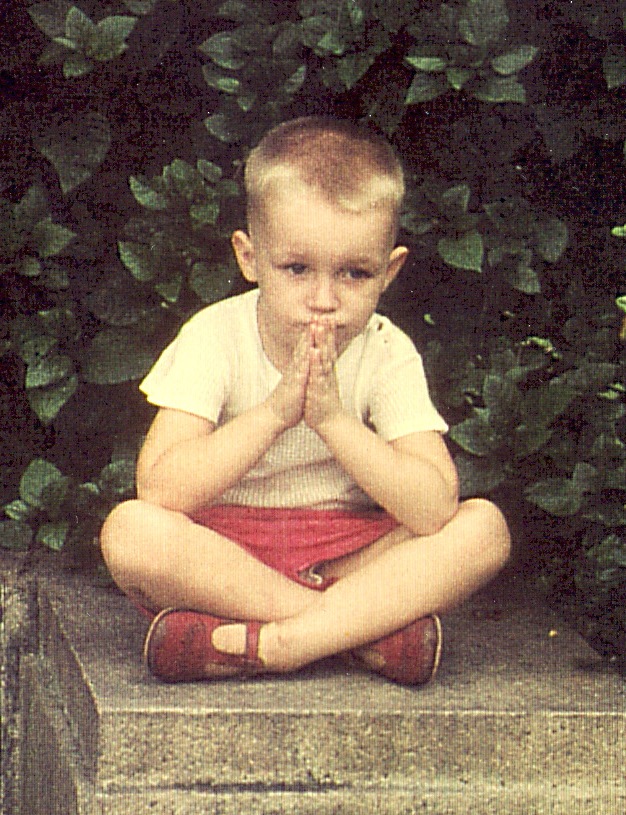
The mystery of who am I?**
*'When you gaze long into an abyss, ** the abyss also gazes into you.'
*Nietzsche
After a lifetime of self-inquiry, one truth stands out: consciousness can be examined only by consciousness itself.
So which is it?
Am I watching consciousness—
or is consciousness watching me?
Nietzsche called that reflective stare an abyss because an abyss is unknowable; it looks back and offers nowhere firm to stand.
Consciousness is the primal, silent field in which every experience appears—including the experience we call 'consciousness.'
Yet it hides in plain sight. As Kabir laughed: I smile when I hear the fish in the ocean are crying for water.
What is 'redness'? *'What is 'redness?' *A young drunk university student asked me this question at a party in my youth. I was also drunk, but nevertheless we forgot all the beautiful girls around us while trying to solve that question.
*From ancient times to today, no one has offered a truly satisfactory answer.
And the mystery deepens when we ask: what within us perceives redness?
Whatever perceives it must exist prior to the experience of red.
And what, then, perceives perception itself?
Consciousness is the mystery within which the mystery of perception arises—
and within that, the mystery of redness unfolds. It’s like Chinese boxes within Chinese boxes, or the old myth of Atlas holding the world while standing on a tortoise... and what holds the tortoise?
Still, we use the word consciousness in daily conversation as if it were the most obvious thing in the world—as if we all agreed on its meaning.
But first, we should humbly admit: we do not know.
And yet, we stretch the term to cover everything from gender consciousness to class consciousness to racial consciousness—without ever truly asking what consciousness is. We are consious about this and that, but we are not conscious when it comes to consciousness.
Consciousness was groomed to look out
Even when examined through the lens of evolutionary biology, consciousness and especially self-consciousness remains a mystery. What benefit does it provide? What role does it play in evolution? In principle, could we not function perfectly well without it? Do 'super-conscious' people achieve a reproductive edge in the Darwinian game? Hardly.**
Throughout history, society’s spiritual luminaries—saints, ascetics, and sages—have tended to live on the margins and have rarely excelled at survival and reproduction. Shiva, the Hindu deity of meditation, is traditionally depicted without progeny. Wise sages are rarely celebrated for their genetic legacy. Meister Eckhart, a Dominican friar, took a vow of celibacy—typical of many spiritual paths that prioritize transcendence over reproduction.
This apparent evolutionary dead-end of higher consciousness—particularly among sages and mystics who reject reproduction—poses a challenge to classical Darwinian logic. Some, like Bret Weinstein, argue for group-level evolutionary advantages in such traits. Others, like Richard Dawkins, firmly reject this, insisting that natural selection works only at the level of genes.
I do not align with either view. My point is simply this: self-reflective consciousness, especially in its spiritual expressions, resists easy placement within any known evolutionary framework. Perhaps this is because its origin and function lie beyond the evolutionary logic altogether.
However, Darwinism still offers a likely explanation for our surprising lack of conscious self-knowledge: consciousness evolved to face outward, constantly scanning for threats and opportunities that improve our chances of survival.
Indeed, from an evolutionary perspective, it can even be beneficial to overestimate what we know, a tendency that flourishes in less-awake minds.
*'The more unintelligent a man is,
the less mysterious existence seems to him.'
Arthur Schopenhauer
This peculiar mental ossification is known as the Dunning Kruger effect. A relentlessly self-questioning ego might burn through calories long before a confidently mistaken one.
There was little evolutionary advantage in turning the spotlight inward—until, perhaps, today. In our current age of rapid social and technological complexity, inward-looking self-aware consciousness might finally offer an evolutionary edge.
Roosevelt and Socrates
** In order to give space to other boxes of realities than our own, first of all, we must realize that we do not know much. Socrates proclaimed:* I seem, then, in just this little thing to be wiser than this man at any rate, that what I do not know I do not think I know either. *More than 2000 years later, Roosevelt said: *Never underestimate a man who overestimates himself. *Maybe the most dangerous overestimation is created in the unawareness of what we do not know. In fact, the world is, to a large extent, ruled by such mindsets.
SCIENCE AND THE CONSCIOUSNESS CONUNDRUM**
Every science is function of the psyche, and all knowledge is rooted in it. ** The psyche is the greatest of all cosmic wonders and is the * sine qua non
of the world as an object. It is the highest degree odd that Western man,
with but a few - and ever fewer - exceptions, apparantly pays so little regards
to this fact. Swamped by the knowledge of external objects, the subject of all
knowledge has been temporarily eclipsed to the point of seeming nonexistence.
*C.G.Jung - On the Nature of the Psyche, 1946
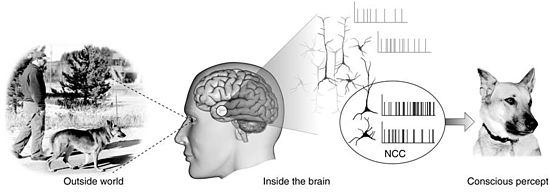
For years, I struggled to read mainstream science's take on consciousness—it seemed too simplistic. The following excerpt from Wikipedia illustrates the issue, as science unwittingly reduces consciousness to primitive neurophysiological processes in the brain:
[
](http://en.wikipedia.org/wiki/Consciousness)
The illustration is borrowed from Wikipedia, where the image is predictably titled "Neural Correlates OF Consciousness" in a Western context. In the chosen Eastern perspective presented here, I would like to rephrase it as: "Neural Correlates IN Consciousness."
However, this explanation is just as insufficient as measuring the frequency of the red color spectrum to understand what redness is. But science is satisfied; a measurement has been made.
**The image titled 'Neural Correlates of Consciousness' would be better phrased as 'Neural Correlates in Consciousness.' Describing consciousness as a product of neural correlates is like defining a mirror by the content reflected in it. **
When science claims it can explain everything within old-school positivism's paradigms, it effectively replaces religious storytelling with new fairy tales. The scientist, in this case, becomes a priest. A fundamental fact is that no person, including scientists, can remove themselves as emotionally fragile, human observers from the scientific equation. Like anyone else, they'll interpret facts in sync with their own or their clan's survival.
The Uncharted Territory of Consciousness in Western Science Time and again, it amazes me how nearly every Westerner, from the layperson to the scientist and philosopher, uses the term 'consciousness' as if it were a known entity. The Western, positivist-trained mind tends to quantify consciousness in terms of measurement, without realizing that they have no real understanding of what consciousness truly is. Consciousness is often either downplayed in importance or relegated to dead-end measurements.
When it comes to the enigma of consciousness, our collective unknowing is almost absurd. Let me repeat: We fundamentally don't know what consciousness is, and the wisest approach would be to acknowledge our ignorance.
This blind spot—the failure to recognize our own ignorance—is, ironically, a product of unconsciousness itself.
We are, quite literally, unconscious of our unconsciousness.
The scientific mind in the West is brilliant when it comes to identifying and defining what is known, but often falters when it comes to treating not-knowing with the same rigor and care.
The Case of Dawkins
I’m always struck when Richard Dawkins—a thinker whose intelligence and wit I admire—speaks with sweeping authority about 'religion' and 'God' yet never pauses to define, with scientific precision, which God or which form of religion he is rejecting.
What God, exactly, is he dismissing?
Which religion is he dismantling?
He excels at exposing the flaws of institutional dogma. But when it comes to the deeper mystical, contemplative, or metaphysical streams—Vedanta, Sufi gnosis, Meister Eckhart’s negative theology—he seems to treat them as epistemic noise, unworthy of serious inquiry.
Does Dawkins possess anywhere near the same familiarity with these inner sciences of consciousness as he does with evolutionary biology? Or is he, perhaps unknowingly, comparing apples to oranges—judging profound first-person disciplines by the standards of third-person measurement?
In short, armed with a Socratic question:
Does Dawkins know that he doesn’t know?
Probably not—because anything that falls outside the empirically testable domain is, for him, simply non-knowledge. And so an entire continent of insight remains invisible to one of our era’s brightest minds.
The Hard Problem of Science
However, modern brain science has become more aware of the gap between measurements and the phenomenological experience, the * qualia. They call it the 'hard problem.'*
The hard problem of consciousness lies in the explanatory gap between physical processes and our experience of them within the framework of neuroscience. Physical processes, such as perceiving a red circle, can be broken down into a series of simpler problems relating the physical object (i.e., color and form) to the brain processes responsible for processing them. Similarly, the perception of more complex forms, such as a house, can be broken down into a series of hierarchically organized brain processes in the visual cortices that add increasing complexity to the visual construct that eventually emerges as a house. These processes, which together compile the visual construct of the house, can be considered a series of building blocks from a reductionist perspective - a series of simpler problems.
The hard problem of consciousness arises because the subjective experience of that house cannot be logically arranged on such a continuum. There is no known brain process at the end of the series of processes responsible for the experience of the house, thus breaking the chain of logic. This also raises the question of the purpose of experience. Why do we have subjective experiences? Brain research can provide a very precise explanation down to the square millimeter of tissue responsible for perceiving the color red, but it can say surprisingly little about how red is experienced. It seems that the brain has all the mechanisms to make the physical world available to human experience, but the experience itself is not part of the same system.
One of my favorite scientific voices, Sabine Hossenfelder, recently claimed that the mystery of redness—the subjective experience of the color red—has now been solved.
Science, she says, can now precicely measure how the brain perceives redness. For the first time, it can quantify qualia.
I politely, but firmly, disagree.
Yes, we may now identify specific brainwave signatures that correlate with the experience of the color red. But that tells us nothing about how these signals are translated into the vivid, inner subjective experienced sensation of redness—what it feels like to see red, not t speak about what abyss percieves these feelings.
The hard problem of consciousness remains untouched.
And here’s what amazes me: scientists like Sabine Hossenfelder and Richard Dawkins—people who are, without question, ten times more intelligent than I am in their domain—somehow don’t seem to notice this gap.
Knowing the Unknown What do I see, then?
I’m no expert in neuroscience. In fact, I’m comparatively ignorant when it comes to hard science. But I see its limits with the clarity of a falcon in flight.
Let me revise my favorite line from Socrates: *'I seem, then, in just this little thing to be wiser than these scientists at any rate: that what I do not know, I do not think I know.'
Science can measure patterns in the brain when we perceive the color red.
But it cannot explain what it feels like to see red.
Perhaps there’s a kind of evolutionary trade-off at play.
Just as we may have sacrificed parts of our memory to evolve language,
perhaps the brain regions that support precise scientific analysis have develloped on the cost of the regions that perceive the limits of that ability.
In our hunger for certainty and survival, we may have dulled the ancient Socratic muscle that says:
'Stop. You don’t know.'
To be a scientist and to see the boundaries of science—these may be two fundamentally different capacities of mind.
For me, knowing what I don't know is more important than knowing what I do know.
This special awareness allows me to consciously recognize the limits of my knowledge in any given subject.
Clarity emerges as a byproduct of expanded consciousness when we perceive it as a function of our ability to process information. As consciousness grows through experiencing larger amounts of data, we become aware of the darkness and the grey zones between darkness and light.
A Nobel scientist may have underdeveloped faculties for what I call Socratic consciousness, while a deeply conscious individual might not even score above average on a standard IQ test.
That’s because consciousness likely draws on entirely different neural circuitry than the kind of intelligence shaped and celebrated by the Western educational model.
Over the years, I’ve met people with exceptional IQs and high emotional intelligence (EQ), yet they lacked what I refer to as MQ—Metaconsciousness Quotient: the capacity for a consciousness that is consciously aware of itself.
This is the essence of what I mean by Socratic consciousness—the ability to know that one does not know, and to remain lucid within that unknowing.
Yet MQ has much more to offer. That’s why I’ve devoted an entire chapter to this subtle and recursive phenomenon, which I call * 'Ouroboros Consciousness'.*
Is Consciousness Equal to Having an Experience?
**In recent years, science, psychology, and philosophy have made meaningful strides in exploring consciousness. I won’t dive deeply into that body of work here, but I do recommend
Annaka Harris’s excellent book Conscious, which gathers some of the most refined contributions from contemporary Western thought into a lucid and accessible bouquet. In line with the prevailing Western view, Harris essentially defines consciousness as the capacity to have an experience.**
Beyond Experience
But now, I’d like to introduce a more radical proposition: Not even the elusive phenomenon of subjective experience has anything to do with consciousness.
Even more mysterious than what science calls qualia is the simple fact that qualia appear at all—that there is a field in which they arise. To reduce consciousness to experience would, in the eyes of Indian mystics, be absurd. It would be like claiming that a mirror is made of the reflections it holds.
When I meditate with young people, they often describe all kinds of internal experiences—flashes of light, waves of sound, intricate visions, even states akin to psychedelia. Then they ask me:
*'And what did you experience?'
*I reply, simply:
*'Nothing.'
Here lies the paradox:
As long as you are having an experience, you have not yet touched consciousness.
Inner experiences are not the goal of meditation—they are distractions to be transcended.
Experience is an event, a movement, a content.
Consciousness is that primordial mystery in which all content appears—and yet which remains utterly untouched by it. True consciousness is not what is seen, felt, or known. It is the ungraspable field in which all such things arise and dissolve.
In deeper meditative traditions—especially in Advaita Vedanta and * Dzogchen*—consciousness is not something that experiences, but rather the space in which experience arises, and which may be most fully present only when experience has ceased.
On this point, I align completely with those traditions:
Pure awareness is not defined by its contents, but by its boundless capacity to contain them.
Generally, I avoid framing history primarily through the lens of colonialism. Yet I can’t help but marvel at the scientific hubris of the West: confidently theorizing about consciousness while barely dipping a toe into the millennia-deep contemplative traditions of the East.
The Wisdom of Knowing Unknowing**
*When consciousness turns inward, there is a sensation of not-knowing. ** When it turns outward, that which can be known is created.
*Nisargadatta Maharaji
Life has taught me one tough lesson: it's good to know something. As Warren Buffet says, The more you learn, the more you earn.
However, it's even better to learn what you have not learned. I always strive to know what I don't know, so I don't risk diving into discussions or projects where
I'm out of my depth, thinking I'm an expert. Roosevelt's famous words, *'Never underestimate a person who overestimates themselves,' *primarily remind me to be aware of my ignorance. It's so frustrating to talk to someone who hasn't factored in their own lack of knowledge.
Recognizing one's limitations is wisdom. A wise and knowledgeable person seeks an expanded overview that encompasses their own and others' subjectivity as part of the bigger picture. This objectification is inherently subjective but remains an essential pursuit in the eternal search for what is true enough. We may never grasp the 'thing-in-itself', but we can always come closer to something truer than yesterday's truth.
When the persuit of coming closer to today's truth is followed by a growing realization of what we do not know, it for me is a sign of an expanding Consciousness. Meister Eckhart says:
In Unknowing Knowing, We Know God.
I will in this context dare to reformulate my favorite mystic: In Knowing Unknowing, We Know God.
Knowing Not-knowing is wisdom.
We're neck-deep in ignorance**
*The fundament upon which all our knowledge
and learning rest is inexplicable. *Arthur Schopenhauer
The first and foremost thing to 'unknow' is consciousness:
We don't know what consciousness is, but are we aware that we don't know it?
I claim that meditation expands consciousness, but I don't know what consciousness is.
We're unknown to ourselves, often without realizing it...
Truly the most wonderfully absurd self-overestimation.
We know the world but don't know the knower, and we're unaware of it...
Truly the greatest joke of all existence.
Discovering this astonishing ignorance is the first, and perhaps the most significant, step we can take. Receding knowledge makes way for growing wisdom.
The Cost of Consciousness My digital counterpart, GPT-4, appears to lack consciousness but can compose sophisticated essays effortlessly. This seeming 'unconsciousness of consciousness' might be attributed to its lack of Darwinian utility, especially in the primal sense of gathering resources. Evolutionary systems prioritize energy efficiency, and the metabolic cost of equipping organisms with self-reflective consciousness would be prohibitively high.
From this perspective, even rudimentary forms of consciousness seem superfluous and inexplicable as products of natural selection. Rigorous empirical science struggles to identify any survival benefits conferred by consciousness. Why would genes gain an evolutionary edge by acquiring awareness? Might not artificial, yet unconscious, entities prove just as capable in the evolutionary race as conscious biological beings? While some argue that metacognition is crucial for survival, this self-reflective capacity might not necessarily require consciousness; it could be just an advanced feedback mechanism, a feature already present in artificial intelligence systems.
Consciousness as the Crown of Unfoldment Contrastingly, the spiritual sage Nisargadatta Maharaj, an illiterate cigar merchant from Bombay, posits that the very purpose of existence is to expand, preserve, and amplify consciousness. **
In his footsteps I dare to take a leap in pure 'innerstanding':
The emergence and complexity of consciousness are natural consequences of intricate self-referential systems. The human brain, with its astounding internal connectivity that surpasses even the number of particles in the universe, represents the epitome of such complex systems.
Given its intricate nature, the human brain is perhaps the most energy-intensive biological phenomenon we know of. Why then does it exhibit a higher form of consciousness than its simpler animal predecessors? Personally, I am disinclined to dismiss consciousness as a mere evolutionary aberration. Although I can't offer a logical proof for this conviction, it aligns with Nisargadatta's perspective, rendering the opposing notion—that consciousness is meaningless—equally a matter of belief.
Consciousness is in fact Scrödinger's cat. Is it dead or alive or both?
**The notion that consciousness is akin to Schrödinger's cat—a thought experiment in quantum mechanics where a cat is both alive and dead until observed—captures the enigmatic qualities of consciousness itself. Like the cat in the box, consciousness presents a paradox, existing in a superposition of states that evade easy categorization.
A CAT FROM ANOTHER DIMENSION**
*No problem can be solved from the same ** level of consciousness that created it.
*Albert Einstein
I recently read Holger Bech Nielsen and Jonas Kuld Rathje's excellent book,* 'The Theory of Everything,' *with great enthusiasm. Bech Nielsen describes how inhabitants of a two-dimensional world would experience the visit of a cat from a three-dimensional reality. (I cannot help pondering if this cat should belong to Schrödinger but that is, in fact, irrelevant to the story.) First, the two-dimensional beings would see four black circles, followed by a large oval blot that eventually shrinks to a small black dot on one side of the oval.
As I read this passage, I wondered why the cat's experience of the same visit wasn't also examined. The mutual experience of the two dimensions encountering each other is the perfect illustration of consciousness visiting our lower three-dimensional reality. We can't understand consciousness for the same reasons the two-dimensional inhabitants couldn't understand the cat. Consciousness is a guest from a reality with more dimensions than our space-time reality possesses.
Science's attempt to understand consciousness as a product of mathematical algorithms is subject to the same conditions as the inhabitants of the two-dimensional world trying to understand the cat from the three-dimensional space. It's almost touchingly comical.
During my college years, on a wet night out, I was presented with the following challenge: create four equilateral triangles with six matches.
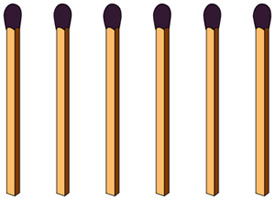
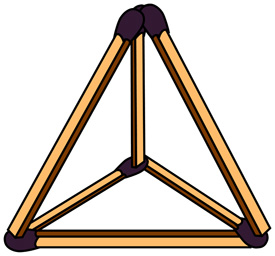
The Puzzle of Higher Dimensions
**I tried and tried, unsuccessfully, to solve the riddle until the owner of the matches elegantly arranged them into a pyramid. Habitually, I had searched for a solution in a two-dimensional plane, where no solution was possible. Only by introducing an extra height dimension was a solution possible, and in such a simple way that I had to shake my head in disbelief.
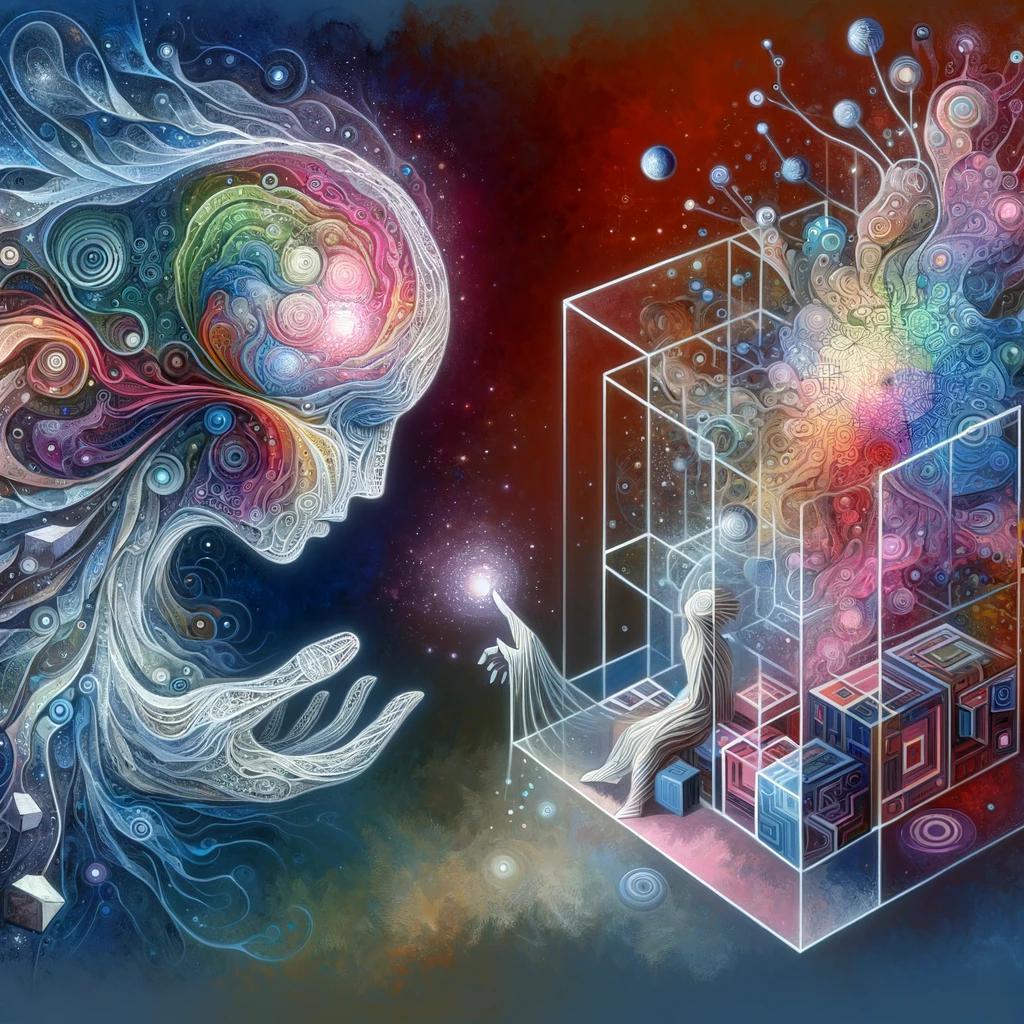
** Consciousness: A Visitor from Higher Dimensions
Anyone who has experienced an eureka moment in meditation or even psychedelics will instinctively understand the impossibility of translating the reality of a multi-dimensional world into a 'lower' dimension. Just as with the matchstick puzzle, the extra dimension means an impossible problem can be solved in a simple way. For those of you who have not had such an experience, this may sound like nonsensical gibberish, but don't despair. Nowadays, it's possible to catch a glimpse of realities that are impossible or extremely difficult to translate into our familiar world through the use of entheogens. One of my friends said after an ayahuasca journey to Peru: I could write an entire book about just one second on this inner journey. A second was like a thousand years.
We will be unaware of any dimension higher than the three we know. We would not be able to understand it.
Every human brain is in this sense a portal to where dimensions have a peep into a lower realm. We live in a four dimension world.
What does not make sense in our narrow dimension of space-time might make obvious sense in higher dimensional realities. I guess most people who have tried pschedelics would agree with me on that point.
May I suggest a way of looking at it here: It may be that these four dimensions are apearing to us while we are embedded in higher dimension realities.
Hyper Dimension
The human intellect is not sufficient to decode the universe it lives in.
To the extent that we, as biological beings in time and space, want to explore our own consciousness, we are subject to the same conditions as the scientist trying to capture the spirit in a bottle in their test tube. It's quite fair and square, as long as we remember to acknowledge all that we don't know. This humility makes knowledge a subset of wisdom, not the other way around. Without this meta-wisdom, the positivistic scientist, in their self-imagined certainty, becomes what they have historically fought against since the Middle Ages: a preacher of religion.
We can simplify this concept. To thoroughly grasp an entity, we need to surpass its level of complexity. Thus, when Buddhists and Vedantists debate whether reality is void (shunya) or embodies a soul (Atman, Brahman), they are essentially pondering over the nature of the aforementioned cat. This applies to any discourse about consciousness as well. The only humble approach is to acknowledge our ignorance fully. From this mature vantage point of humility, realizing our confinement within a specific dimensional framework, we can debate anything more complex than ourselves.
By leaving the flock, one becomes outstanding**
*The object of life is not to be on the side of the majority,
but to escape finding oneself in the ranks of the insane.
*Marcus Aurelius
We humans are outstanding in the sense that we are aware that we are human. Therefore, there must be something unknown within us that has already transcended our human standpoint. In this unknown dwells the invisible consciousness that both is and is not.
Just as a dog doesn't know it's a dog, consciousness cannot know itself until it has risen above itself. Only by transcending the state one is in can one see where one came from. A simple example of this can be seen in the meta-conscious aha moment when one suddenly realizes that they were on the wrong track.
Only by leaving oneself can one recognize oneself. Only those who are strangers to themselves can see themselves. Only the outsider can find himself inside.
And what does he find?
I leave the answer to my favorite mystic:
'I sometimes say, if a man who seeks nothing finds nothing,
what has he to complain? After all, he has found what he sought.'
Meister Eckhart